
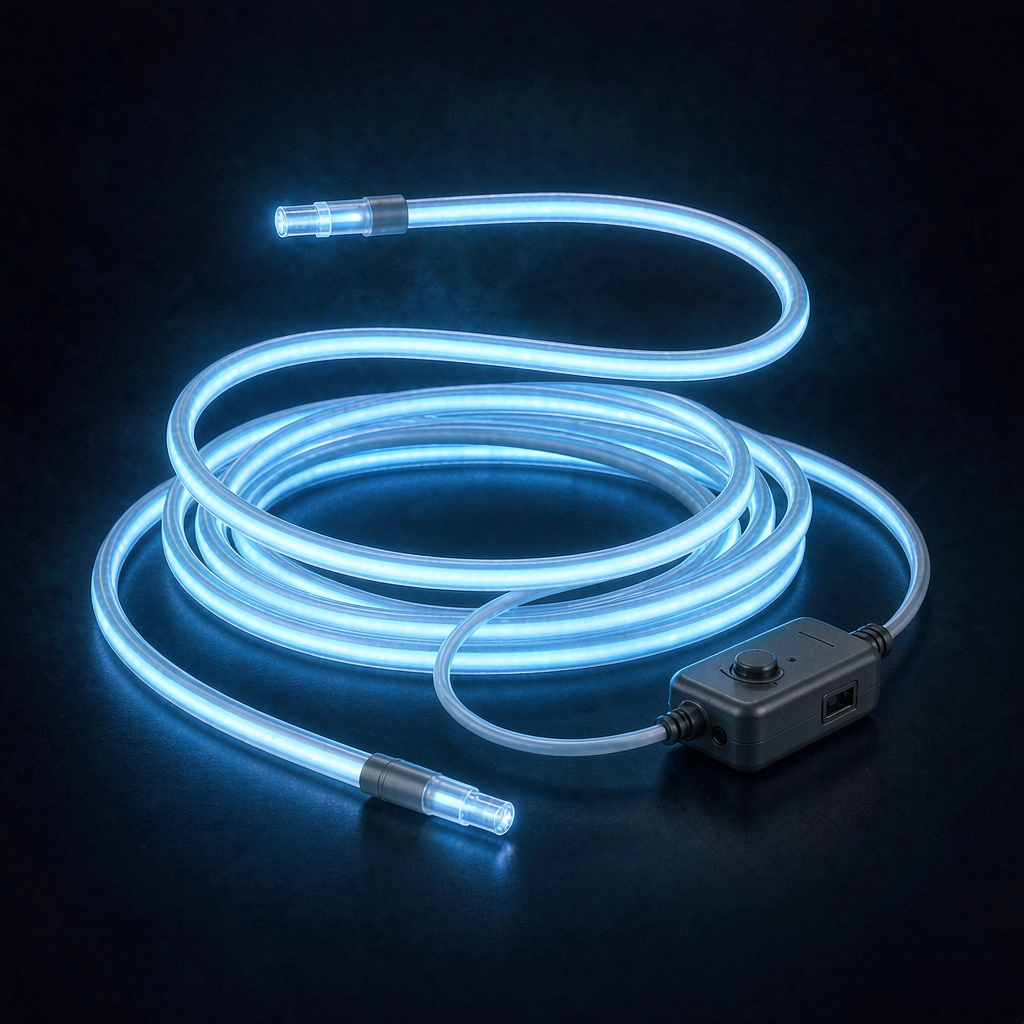
Ambient lighting is one of the few modifications that everyone in the car notices, including passengers who could not care less about cars. It is also one of the easiest to get wrong — not mechanically, but electrically. A kit that draws power from the wrong place will either throw a fault code, drain your battery, or flicker every time the engine start-stop system kicks in.
Here is how the systems actually work, and what to check before you buy.
The two ways a kit gets installed
OEM-style replacement panels
Light guides are bonded into replacement trim pieces — door cards, dashboard strips, footwell panels — that swap out for the factory parts. The result looks factory because it is factory-shaped. Installation is longer, the parts are platform-specific, and fitment is unforgiving: a millimeter of difference at the door card edge is visible every time you open the door.
Add-on strips and fiber-optic guides
A flexible LED strip or a fiber-optic cable with a single light source at one end is tucked into panel gaps. Installation is faster and cheaper, and the same strip can be trimmed to fit several vehicles. The trade-off is that a strip shoved into a panel gap eventually works its way back out, and the light source at the end of a long fiber run can be noticeably dimmer than the near end on cheap kits.
Electrical: where the kit takes its power
This is the part that decides whether the install is clean or a permanent annoyance.
- Fuse tap on a switched circuit — the safest default. The lights come on with the ignition and go off with it. Choose a circuit that is genuinely switched, not one that stays live for ten minutes after you lock the car.
- Door module tap — lets the lighting follow the door-open signal, which looks the most OEM. It also means the install now involves a module that is monitored by the vehicle’s body computer.
- OBD or cigarette-lighter plug — fine for a temporary setup, and the honest choice if you are leasing. Not fine if you want the wires hidden.
- Direct battery feed — almost always wrong for interior lighting. It is how you end up with a flat battery and a two-amp parasitic draw you cannot find.
CAN-bus, error codes, and why some cars complain
Modern vehicles monitor the circuits they care about. Two things trigger a fault:
A bulb-out error. If you replace a factory incandescent with an LED that draws a fraction of the current, the body computer concludes the bulb has failed and lights up a warning. The fix is either a load resistor or coding the module to accept LEDs — and on vehicles that support it, coding is the cleaner choice because a resistor gets hot and is just a heater pretending to be a bulb.
A module that expects a specific signal. If your kit piggybacks on the door module or the footwell lighting circuit, the vehicle may read the extra load as a fault. Kits designed for a specific platform include a harness that presents the correct load and impedance; universal kits do not.
Before ordering, the two questions worth asking are: does this vehicle monitor the footwell and door lighting circuits, and does the kit include a harness designed for that.
What separates a kit that lasts three years from one that lasts three months
- IP rating on the strip. Interior strips do not need to be submersible, but they do live near a door seal where condensation collects. IP65 is the sensible floor.
- Adhesive and mounting method. Tape alone fails in a hot cabin. Good kits use a rigid channel or mechanical clips, with tape as a secondary hold.
- Heat management. A dense strip at full brightness in a closed panel gets warm. Over-driven strips fade to a different color within a year — usually the blue channel first, which is why aging kits turn pink.
- Color consistency across panels. If the door strips and the dash strip come from different production batches, they will not match at low brightness. Ask whether the kit ships as one matched set.
- Control method. App control is convenient until the app is abandoned. A kit with a physical button or an integration with the factory screen ages much better.
Fitment: what actually varies between model years
Ambient lighting kits are body-panel specific, so the fitment questions are different from a mechanical part:
- Facelift year. A mid-cycle refresh often changes the door card and the dashboard trim profile. Kits are usually split by pre-facelift and post-facelift, and the split is not always the year you expect.
- Trim level. Vehicles that already have factory ambient lighting have different wiring and different panel cutouts than base models. Retrofitting into a car that already has it is a different job from adding it to one that does not.
- Sunroof and speaker packages. Both change the door card, which changes where a light guide can run.
Send us the model year, trim, and a photo of the door card and we will tell you which kit matches — and if your car already has factory lighting, whether a retrofit is worth the work at all.
Browse the interior and electronics range, or send your vehicle details for a fitment confirmation.
Related reading
- What “fits all” really means — the fitment questions that apply to every interior part
- Coilovers vs lowering springs — if you are already taking the interior apart, this is the other upgrade owners usually do at the same time