
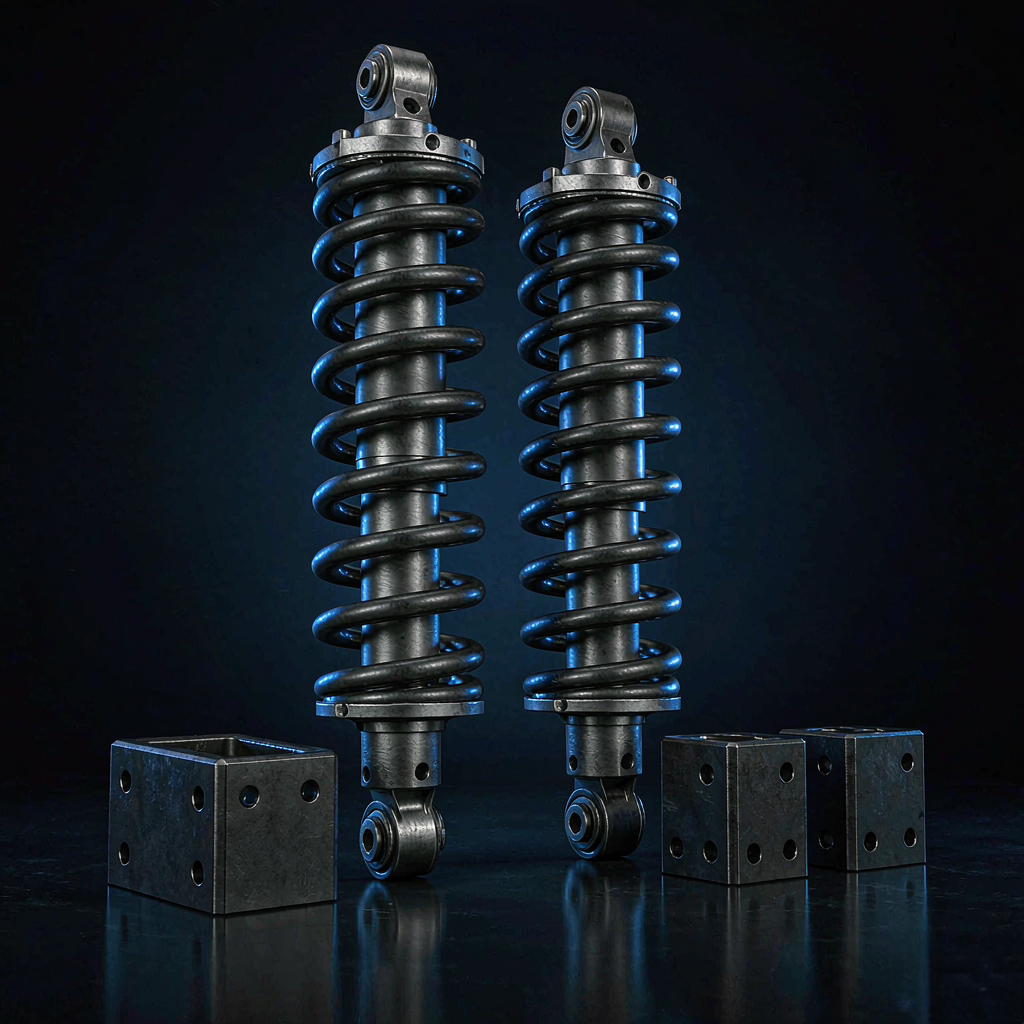
Two owners with the same truck ask us for two completely different parts. One wants the front end to stop pointing at the sky. The other wants to clear 35-inch tires without cutting the fenders. Both of them say “I need a lift,” and one of them is about to spend money on the wrong thing.
This guide separates the two, explains what each one actually changes about your suspension geometry, and tells you where the expensive mistakes usually happen.
What a leveling kit really does
Most trucks and body-on-frame SUVs leave the factory with rake — the rear sits higher than the front. That is deliberate. It keeps the truck level when you load the bed or hitch a trailer.
A leveling kit raises the front by roughly 1 to 2.5 inches to close that gap. Mechanically it is a simple part:
- A strut spacer that sits on top of the coilover on most modern independent front suspensions
- A coil spacer on older trucks with a separate shock and spring
- A torsion key on trucks that still use torsion bars, which re-indexes the bar rather than adding height
What it does not do is increase wheel travel, spring rate, or load capacity. The suspension still has the same amount of droop and compression it had before — you have simply moved its neutral position upward. That distinction matters when you actually use the truck.
What a lift kit actually changes
A proper 4 to 6 inch lift is not a taller spacer. It repositions the whole front differential and steering geometry so the truck can sit higher without destroying the angles that keep it driving straight.
Depending on the platform, a complete kit includes:
- Drop-down brackets for the front differential and lower control arms
- Spindles or knuckles that raise the wheel mounting point without over-extending the strut
- Extended brake lines and ABS wiring so nothing is stretched at full droop
- New upper control arms with corrected ball joint angles, on trucks that need them
- Rear blocks, add-a-leaf, or replacement leaf packs, plus longer shocks
- Bump stop extensions and, often, a steering stabilizer or a modified pitman arm
That list is why a real lift kit costs several times what a spacer does. You are not buying height. You are buying back the geometry that height took away.
The four failure points nobody warns you about
1. CV axle angle
Every inch you lift the front of an independent suspension increases the angle at the inner CV joint. Past roughly three inches on many platforms, the boot starts to run hot, the joint wears faster, and eventually you get a vibration under acceleration that feels like a bad tire balance but is not. Dropped differential brackets exist specifically to keep that angle in range. A spacer kit does not have them.
2. Caster and alignment
Lifting changes caster, and caster is what makes a truck track straight at highway speed. On some trucks the factory adjustment range is enough to bring it back. On others it is not, and the fix is replacement upper control arms with built-in correction. If a shop tells you a 4-inch lift “aligns fine” without asking which arms you are running, ask again.
3. Driveline vibration
Two-piece rear driveshafts have a carrier bearing that expects a specific angle. Lift the rear four inches with blocks and the working angle of the U-joints changes. The result is a shudder on takeoff that most owners misdiagnose as a transmission problem. Shims, a one-piece shaft, or a proper carrier bearing drop bracket solve it — but only if somebody thinks of it before the truck goes back on the road.
4. Tire clearance versus tire size
“Fits 35s” is a marketing line, not a specification. Whether a 35 clears depends on wheel offset, tire width, and whether you are willing to trim. A 35×12.5 on a +18 offset wheel and a 35×12.5 on a -12 offset wheel behave nothing alike on the same truck. This is the single most common reason a customer calls us after installation.
How to choose
Take the leveling kit if: you want the stance fixed, you stay on pavement and fire roads, you tow or haul regularly and want to keep the factory rake under load, and you are keeping stock-size or one-size-up tires.
Take the lift kit if: you are going to 35-inch tires or larger, you use the truck off-road where articulation matters, you are adding a winch bumper or rear carrier that changes the weight distribution, or you want the modification to be defensible when you sell the truck.
Neither, if: your truck has air suspension or adaptive dampers. Both systems need a specific approach — sensor links or a module recalibration — and a generic spacer can put the system into a fault state. Tell us the trim level before anything else.
The fitment details that decide the part number
Before we quote a suspension part we need four things, and they are not optional:
- Exact model year — mid-cycle changes are common. A 2019 and a 2020 can take different strut mounts.
- Cab and bed configuration on pickups, because rear spring rates differ by wheelbase
- 2WD or 4WD, and whether the truck has a factory lift or off-road package already
- Trim level, because that is what determines whether you have adaptive dampers, air suspension, or a magnetic ride system
Send those and we will confirm in writing which kit fits and what it includes — not “probably fits,” but a specific answer you can hold us to. If you are still deciding between a level and a lift, tell us the tire size you want to end up with and we will work backwards from there.
Ready when you are: send your year, make, model and trim, or browse the suspension and chassis range to see what we currently build.
Related reading
- Coilovers vs lowering springs — the same geometry logic, applied to cars that are going down instead of up
- Hubcentric vs lugcentric wheel spacers — read this before you change wheel offset to clear a bigger tire